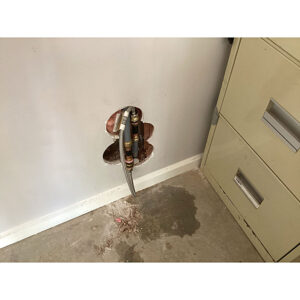
99% of the time that people have a water leak, they only notice it after the damage is done.
In 30% of all cases, the consequences of a water leak are severe and very costly.
Leaking water pipes in any Canberra suburb can lead to very high water bills, health risks from mould, and visual and structural damage to property, with the most common water leaks occurring in hot and cold water pipes. Sewerage and stormwater pipes can also leak.
Why can water leaks be difficult to find, and why is it worse in Nicholls, Gungahlin, than the rest of Canberra?
In most ways, the water pipes in Nicholls are installed similarly to in other Canberra suburbs.
There are 2 areas where water pipes can leak. They can leak outside, between the water meter and the house, or they can leak inside/under the house. If you’re really unlucky, there can be multiple leaks – inside and out.
How to find leaks in plastic water pipes
Most water pipes are buried or hidden in walls. Unless you can see the leak in the pipe, or a hole suddenly appears in the ground or in your walls, there is very little that homeowners can do to find leaks in their water pipes.
Electronic tools such as transmitters and receivers, small CCTV push cameras, thumpers, thermal cameras, internal line tracers, inert gas detectors and listening devices are required.
Nitrogen air mixes, compressed air and conductive fluids can also be used. However, none of these are of any use if the operator is inexperienced.
Can we professionally find and fix leaks in pipes? Yes, we can – and we can help today.
What causes leaks in buried water pipes between the water meter and the house?
Water pipes are buried at depths ranging from 300mm up to 3000mm. The average depth is 700mm.
Pipes are just as likely to be found buried under concrete paths, driveways or pavers, as they are under lawns and gardens.
In Canberra’s older pre-1965 suburbs, the water pipes are usually constructed from galvanised steel, while from 1965 to 1990 they were made from copper. Houses from 1990 onwards may have either copper or plastic water pipes.
As it is more economical to do so, plumbers will often use one trench to accommodate the water, stormwater and sewerage pipes. These trenches are backfilled with gravel.
This is often the reason that external water leaks do not appear at the surface – as the water can easily track through the gravel away from the surface and even into the sewer or stormwater pipes.
The Canberra suburb of Nicholls was developed from the early to late 1990s, so the pipes from the water meter to the house are mostly plastic.
These pipes are likely to be grey polybutylene with push-fit O-ring fittings or crimped ring fittings. Most leaks will occur at these fittings.
Some leaks will be caused by abrasion against hard objects buried in contact with the pipes in the trench, which can split the pipe at any point along its length.
What causes leaks in water pipes between the connection at the house and the wet areas in the house?
In Canberra, hot and cold water pipes are prone to freezing if they are installed in roof cavities. Therefore, they are likely to be buried under the internal concrete floor slab.
Pipes only penetrate the slab to turn up in the walls of the wet areas to feed your taps and toilets.
Pipes are installed like branches from a tree under the house slab between multiple wet areas. These are called loops (i.e. a loop between the kitchen and bathroom).
Water pipes in the house will likely be copper in suburbs pre 1965 until the present day, or plastics from 1990 until the present day.
In older Canberra suburbs (circa 1960s), copper pipes were installed in the concrete slab. These pipes frequently leaked because of slab cracks and movement, and concrete and copper being chemically incompatible when in contact with each other.
These days, copper and plastic water pipes are buried below the slab at depths ranging from 100mm - 1500mm. The average depth is 450mm.
Copper pipes will react and corrode when in contact with the crushed granite that is laid under concrete slabs in Canberra, as will the copper in plastic pipe fittings.
Plastic pipes should be inside a protective conduit when buried under slabs.
Where floors consist of timber bearers and joists instead of a concrete slab, pipes will be clipped to the underside of these timbers. These leaks are usually a lot easier to fix.
As mentioned earlier, the water pipes in Nicholls are likely to be grey polybutylene with push-fit O-ring fittings or crimped ring fittings. It is rare to find fittings buried under internal concrete slabs.
Most leaks will occur at these fittings. Some leaks will be caused by abrasion against hard objects buried in contact with the pipes under the slab. Leaks also occur where the pipe penetrates the concrete slab.
What causes water leaks in pipes within the walls of buildings in Canberra?
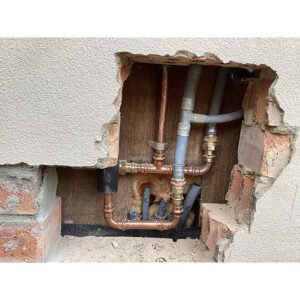
Pipes in walls are copper or plastic and will branch off to each plumbing fixture or tap.
Old copper water pipes can leak from fatigue caused by years of expansion and contraction and from a breakdown of the soldered joints.
In all wet areas apart from standalone toilets, there will be a hot and cold pipe. Standalone toilets will just have a cold pipe.
To prevent rattling, pipes are clipped to the wall frames.
Water pipes may or may not be insulated.
Copper-to-plastic pipe adaptors with O-ring joints are common near hot water systems.
To save money, plumbers will use the least number of fittings possible – avoiding installing bent elbow fittings if they can. Plastic water pipes can split when formed into tight radius bends. Plastic water pipes will leak if they are not engaged straight or fully seated into a fitting.
Mice will eat through water pipes - especially if they have just ingested a dose of poison.
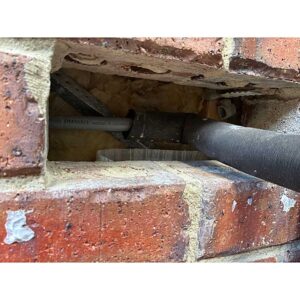
The polybutylene pipes in the walls of Nicholls homes will leak for the reasons above, along with deteriorating fittings and abrasion against metal wall bracing and strapping.
Most plastic pipes will leak at joints. Polybutylene can leak anywhere along the pipe. This issue is so common that most plumbing suppliers in Australia refuse to stock it.
We have also found nails and screws through the walls of pipes. It may take 20 or more years to show, but it is usually after the nail or screw has rusted that a leak forms.
Why are we called to fix so many water leaks in Nicholls in the Gungahlin District of Canberra?
Frequent water leaks occur in Nicholls because when the majority of houses there were being built, the most readily available and easy-to-use pipe was polybutylene with push-fit fittings.
How can Canberra Water Leak Locating & Detection Service help?
Since 1991, we have been detecting and locating water leaks in Canberran water pipes made from galvanised steel, copper and all brands of plastic pipes. If you are in Nicholls, ask around your street and there’s a good chance we’ve fixed a leak for a neighbour.
If you have a leaking pipe in Nicholls call 0448 844 911 for the least destructive water leak repair options.
